
Red Light Therapy and Lavender: An Evening Ritual for Inflammation, Recovery, and Rest
People often ask me how I manage to do so many different things in a single day.
From the outside, it can look like a lot: farming lavender in the high desert, writing and illustrating books, running workshops, caring for the land, managing a small business, and all while doing IVF currently. I will say first that I have an incredible team that helps make all of this possible, but my to-do list can still become overwhelmingly long. One lesson I’ve had to learn after hitting burnout a couple of times is that none of this work is sustainable without a steady commitment to taking care of my body.
Evenings on the farm are not necessarily my favorite time of day, but the most important. They are the moments when the work finally quiets enough for me to shift from doing to restoring. It’s when I focus on lowering inflammation, calming my nervous system, and preparing my body to begin again the next morning.
As a woman living with endometriosis, inflammation, discomfort, and stress are things I have to pay close attention to. When my body is already carrying a lot, everything else becomes harder: the long hours of physical farm work, the creative focus needed for illustration and writing, and even getting the restorative sleep I need to begin again the next day.
Over time I’ve developed a number of small evening practices that help my body recover. None of them are complicated, but together they create a rhythm that allows my work to be sustainable.
One pairing that has become especially helpful is red light therapy and lavender.
They are very different tools, but I love using them together. Red light has become part of how I support my body after physically demanding days, while lavender gives me a sensory cue to slow down and transition out of work mode.
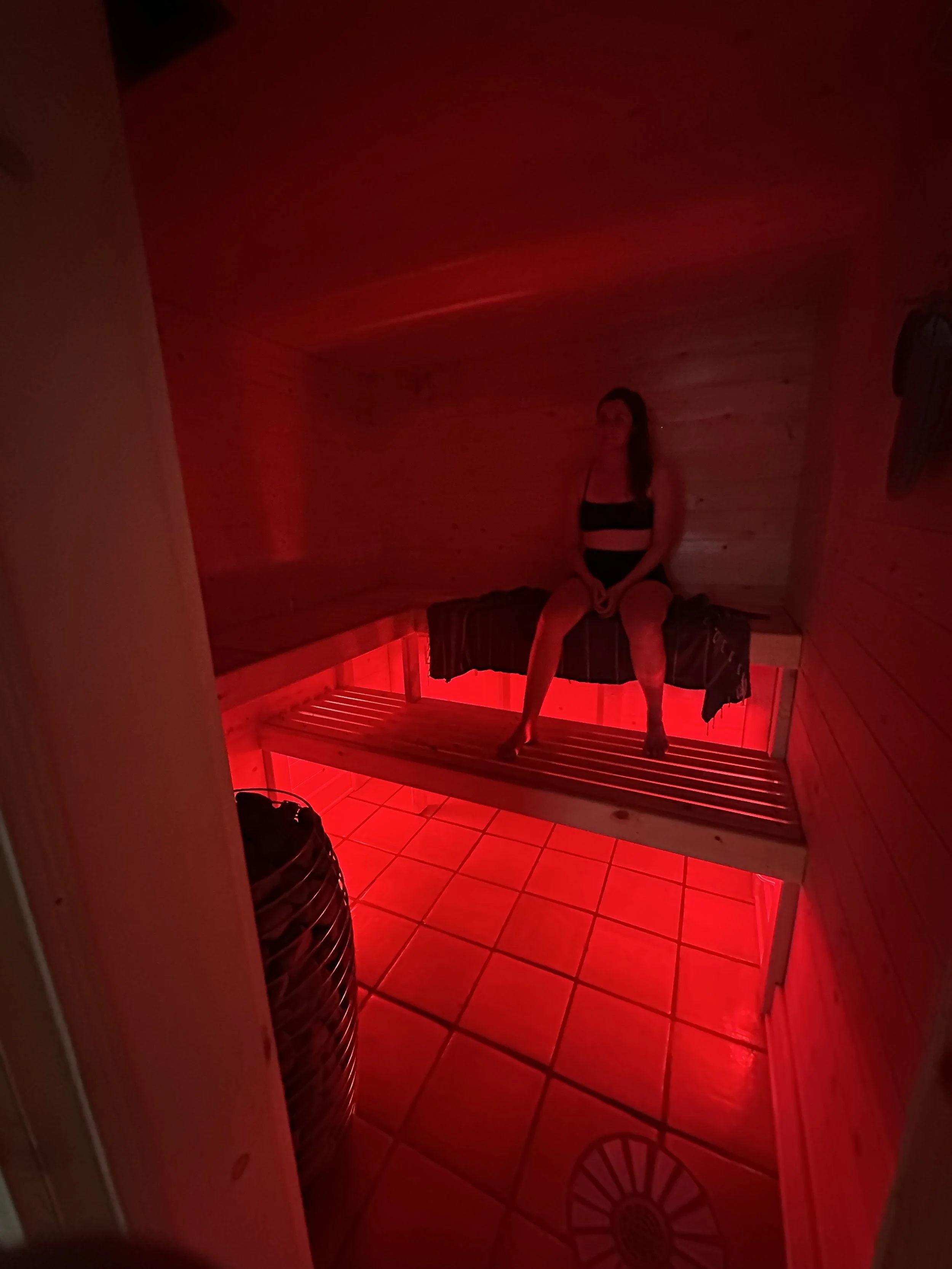
Wood-fired Sauna with Redlights at Mesa Verde Lavender
Understanding How Red Light Therapy Works
Red light therapy, sometimes called photobiomodulation, uses specific wavelengths of red and near-infrared light to stimulate biological processes inside the body.
At the center of this process are the mitochondria, tiny structures inside our cells that produce energy in the form of ATP. These mitochondria are often described as the “powerhouses” of the cell because nearly every function in the body depends on the energy they produce.
Research over the past several decades suggests that red and near-infrared light may interact with an enzyme in the mitochondria known as cytochrome c oxidase. This interaction is thought to influence ATP production and other cellular processes involved in energy metabolism.
That may sound abstract, but it is one reason researchers are interested in photobiomodulation for areas such as tissue recovery, inflammation, circulation, and skin health. The evidence varies depending on the condition being studied, the wavelength and dosage used, and the type of device.
A widely cited review published in Photomedicine and Laser Surgery describes how low-level light therapy can enhance mitochondrial function and improve cellular energy production.
https://pmc.ncbi.nlm.nih.gov/articles/PMC4355185/
Another large review examining photobiomodulation research explains how red and near-infrared light influence inflammatory pathways and oxidative stress within tissues.
https://pmc.ncbi.nlm.nih.gov/articles/PMC5523874/
In practical terms, this is why many people use red light therapy to support muscle recovery, skin health, and inflammatory conditions.
For me, the most noticeable benefit is simply how much I enjoy using it as part of my recovery routine after long physical days on the farm, especially when my body feels sore, tense, or uncomfortable.
Lavender and the Nervous System
If red light therapy works at the level of cellular metabolism, lavender works in a different but equally important system: the nervous system.
Lavender has been used for centuries as a calming herb, but modern research has begun to clarify why its effects are so consistent across cultures and traditions.
Research suggests that aromatic compounds in lavender may influence several pathways involved in stress and relaxation, including GABA-related signaling. The exact mechanisms are still being studied, but clinical research has found promising associations between lavender aromatherapy and reduced anxiety, relaxation, and sleep.
A systematic review examining clinical trials found that lavender essential oil significantly reduced symptoms of anxiety in multiple study groups.
https://pubmed.ncbi.nlm.nih.gov/31655395/
Additional analyses of aromatherapy research have found lavender inhalation can meaningfully reduce anxiety markers and support relaxation.
https://www.mdpi.com/2227-9032/11/22/2978
Studies exploring lavender and sleep quality have also reported improvements in sleep patterns and reductions in stress markers when lavender aromatherapy is used before bedtime.
https://www.nature.com/articles/s41598-019-54529-9
These findings help explain something herbal traditions have long understood intuitively: scent can communicate directly with the nervous system in a way that words and thoughts cannot.
Why the Two Work So Well Together
What I appreciate about combining red light therapy with lavender is that the two support the body through different but complementary systems.
What I appreciate about combining red light therapy with lavender is that they encourage me to pay attention to two different sides of recovery.
Red light gives me a reason to stop and tend to my physical body after a long day, while lavender helps create a sensory transition from work into rest.
Together, they have become a simple ritual that reminds me recovery is not just about sore muscles or tired skin. My nervous system needs a chance to come down from the day too.
After a long day of work, that combination can feel remarkably grounding.
My Evening Routine on the Farm
My evening routine is simple, and it has evolved slowly alongside the rhythms of farm life.
After coming in from the fields, I begin by washing the dust and wind from my face. I usually mist my skin with lavender hydrosol and apply a moisturizer before settling into the quieter part of the evening.
When my muscles are sore or my body feels especially tired, I use a small Boncharge Mini red light device. I often place it over my abdomen because that is an area where I personally tend to experience discomfort and tension related to endometriosis. I don’t consider red light therapy a treatment for endometriosis itself, but I enjoy incorporating it into my broader recovery routine. Other times I use it over tight or tired muscles.
The session itself is short - usually around ten minutes - but the pause is just as valuable as the light itself. It’s a moment when the day’s momentum finally slows.
Beside my bed I keep a small lavender sachet. On evenings when the day has been especially stressful, I’ll simply take a few slow breaths of its scent. That small act alone can signal to my body that the workday has ended.
Before sleep I often spray lavender magnesium oil on my belly and legs. I love using the magnesium spray as part of my nighttime ritual, especially on tired muscles and the bottoms of my feet, while the lavender scent helps mark the transition into rest.
If the wind has been strong or the work particularly dusty, I’ll also massage lavender Tallow Balm or our Golden Glow Salve onto especially dry areas. After hours outside in the Colorado sun, wind, and dust, my skin is usually very ready for the extra moisture.
These small steps are not dramatic, but they create a rhythm of care that allows my body to recover and begin again the next morning.
Small Practices That Sustain a Big Life
Working close to the land teaches you quickly that sustainability applies to the body as much as it does to soil or ecosystems.
Over time I’ve learned that the most supportive practices are rarely the most complicated ones. Instead they tend to be small rituals repeated consistently — moments of restoration that gradually build resilience.
In my daily routine, red light therapy and lavender have become two such practices.
For me, they create a simple way to pay attention to both physical recovery and nervous system regulation while gently transitioning from work into rest.
And sometimes, that quiet transition is exactly what the body needs most.
A quick note: This is simply the evening routine that works well for me and is not medical advice. Research into photobiomodulation and lavender aromatherapy is still evolving, and results vary depending on the person, condition, device, dose, and method of use. If you are managing a medical condition, pregnant, undergoing fertility treatment, or using red light therapeutically, talk with your healthcare provider about what is appropriate for you.
